

How to Get NCLC 7 in French and Move from Basic to Boardroom Ready

The jump from NCLC 5 to NCLC 7 feels small on paper. In real learning, it is one of the sharpest climbs in French.
At NCLC 4 or 5, communication works. You can order food, introduce yourself, ask for directions, describe your routine, and manage simple conversations. This is useful French. It is also still basic French in the way official evaluators see it.
NCLC 7 is different. It asks for control. You need to follow faster speech, understand opinion and nuance, write with structure, and speak without sounding as if every sentence is being translated from English or Hindi in your head.
For Express Entry French category draws, NCLC 7 is the threshold that matters. It is roughly aligned with CEFR B2, the level where French becomes serious enough for academic, professional, and formal situations. This is where many learners get stuck, not because they lack effort, but because their study method still belongs to the beginner stage.

Why NCLC 5 feels comfortable but does not reach NCLC 7
NCLC 5 often feels like a breakthrough. You can finally “speak French”. You can survive many everyday situations. You understand familiar topics if the speaker is clear. You can write short messages and explain simple needs.
That comfort can become a trap.
At this level, learners often depend on:
Short sentences
Familiar topics
Memorised expressions
Slow audio
Direct translation
Repeated vocabulary
Safe grammar patterns
This works in daily life. It does not work well in a test built to measure range, accuracy, fluency, and comprehension.
NCLC 7 requires a wider command of the language. You must handle topics that may not be personal or familiar. You need to discuss education, work, society, technology, environment, immigration, health, or media. You need to give reasons, compare ideas, soften opinions, and defend a point of view.
That is the real difference between NCLC 5 and NCLC 7.
At NCLC 5, a learner may say:
Je pense que c’est bon parce que les gens aiment ça.
At NCLC 7, the same idea becomes:
À mon avis, cette mesure peut être positive, car elle répond à un besoin réel. Cela dit, elle risque aussi de créer certains problèmes si elle n’est pas bien encadrée.
The second answer is not just longer. It has structure. It shows contrast. It controls nuance. It sounds like a person building an argument, not only reporting a thought.
That is the core of How to get NCLC 7 in French. The work shifts from “Can I say something?” to “Can I explain, organise, and defend it clearly?”
What NCLC 7 actually expects across the four skills
NCLC 7 is not only a speaking target. For French category eligibility under Express Entry, the target applies across the four tested abilities: listening, reading, writing, and speaking.
A strong learner cannot depend on one skill to cover the others. Each skill has its own trap.
Skill | NCLC 5 habit | NCLC 7 expectation |
Listening | Understanding slow, familiar speech | Following natural-speed audio with opinions and details |
Reading | Finding clear facts in simple texts | Understanding argument, structure, tone, and implied meaning |
Writing | Producing short personal messages | Building organised responses with reasons and examples |
Speaking | Answering direct questions | Sustaining discussion with fluency, logic, and precision |
Listening needs speed and tolerance for uncertainty
At NCLC 5, learners often pause audio, replay every line, and panic when they miss a word. At NCLC 7, you need to keep going even when a few words escape you.
Real listening is not word-by-word decoding. It is pattern recognition.
You need to catch:
The main idea
The speaker’s position
The reason behind that position
Contrast markers
Examples and consequences
Changes in tone or direction
Words like `pourtant`, `en revanche`, `même si`, `étant donné que`, and `par conséquent` become essential. They tell you how ideas connect.
Reading needs more than vocabulary
Many learners blame vocabulary when their reading score stalls. Vocabulary matters, but structure matters just as much.
At NCLC 7, a text may present an argument, a counterargument, a condition, or a recommendation. You need to see how paragraphs work together.
Useful reading questions include:
What is the author’s main point?
Is this sentence an example, reason, contrast, or conclusion?
What does the writer imply but not state directly?
Which option matches the exact meaning, not just a similar word?
This is where basic reading becomes analytical reading.
Writing needs a clear architecture
NCLC 7 writing is not judged only by grammar. Evaluators look for organisation, task completion, vocabulary range, connectors, and clarity.
A weak answer may include correct sentences but still feel flat:
Je suis d’accord. C’est une bonne idée. Les gens peuvent apprendre. C’est utile pour le travail.
A stronger answer builds a position:
Je suis plutôt favorable à cette initiative, car elle peut aider les adultes à améliorer leurs compétences professionnelles. Par exemple, une formation courte en ligne permettrait à une personne employée de progresser sans quitter son poste. En revanche, il faudrait aussi prévoir un accompagnement pour les personnes qui ne sont pas à l’aise avec les outils numériques.
This answer has a position, reason, example, contrast, and condition. That is boardroom-ready French in test form.
Speaking needs spontaneous structure
Many learners can prepare a two-minute monologue. Then a follow-up question breaks the rhythm.
NCLC 7 speaking requires flexibility. You need to answer, expand, clarify, and sometimes correct yourself smoothly.
A useful speaking pattern is:
Give your position.
Add one clear reason.
Give a concrete example.
Add contrast or limitation.
Close the idea.
For example:
Je dirais que le télétravail peut être bénéfique, surtout pour les personnes qui gagnent beaucoup de temps dans les transports. Par exemple, dans une grande ville, éviter deux heures de trajet par jour peut améliorer la qualité de vie. Cela dit, il faut garder un minimum de contact avec les collègues, sinon la communication peut devenir plus difficile.
This structure works because it gives the listener a path to follow.

The grammar shift from basic sentences to controlled complexity
The plateau often begins when learners know “enough grammar” for daily life. NCLC 7 demands more than knowing rules. It asks for controlled use under pressure.
The key is not to study every advanced grammar topic at once. Focus on the structures that help you express complex ideas.
Master subordinate clauses
Subordinate clauses allow you to connect ideas with precision.
Useful structures include:
`parce que`
`puisque`
`même si`
`bien que`
`alors que`
`afin que`
`étant donné que`
Compare:
Les cours en ligne sont utiles. Les gens travaillent.
With:
Les cours en ligne sont utiles, surtout pour les personnes qui travaillent à temps plein.
Or:
Même si les cours en ligne offrent plus de flexibilité, ils exigent aussi beaucoup d’autodiscipline.
This is the kind of sentence lift that matters at B2.
Use contrast without sounding mechanical
Many learners overuse `mais`. At NCLC 7, contrast needs variety.
Try:
`cependant`
`pourtant`
`en revanche`
`toutefois`
`cela dit`
`d’un autre côté`
Example:
Cette solution semble efficace à court terme. Toutefois, elle pourrait coûter cher si elle est appliquée à grande échelle.
This sounds more mature than repeating `mais` in every answer.
Build cause and consequence
Official tasks often ask you to explain why something matters. That means cause and consequence must become automatic.
Useful connectors include:
`car`
`grâce à`
`à cause de`
`c’est pourquoi`
`par conséquent`
`ainsi`
`cela entraîne`
Example:
Le coût du logement augmente dans plusieurs grandes villes. Par conséquent, de nombreux jeunes adultes retardent leur projet de vivre seuls.
This sentence shows social reasoning, not just grammar knowledge.
Control the conditional
The conditional is essential for polite suggestions, hypothetical ideas, and balanced opinions.
Examples:
Il serait préférable de proposer plusieurs options.
Cette mesure pourrait aider les familles à faible revenu.
On devrait aussi tenir compte des besoins des régions rurales.
These forms are practical for writing and speaking. They make your French sound less basic and more measured.
How to train for NCLC 7 without wasting months
The move from NCLC 5 to NCLC 7 needs a different routine. More passive exposure is not enough. Watching French videos can help, but only if paired with active output and correction.
A serious study week should train all four skills with pressure.
Step 1. Replace slow audio with natural audio
Begin using audio that feels slightly too fast. News reports, interviews, public service clips, and exam-style recordings are useful because they contain formal vocabulary and structured speech.
Do not try to understand every word. Train in three passes:
Listen once for the topic and main idea.
Listen again for arguments, examples, and connectors.
Listen a third time to write down useful phrases.
After that, summarise the audio in French:
Le document parle de... La personne explique que... Elle ajoute que... Le problème principal est...
This builds listening and speaking at the same time.
Step 2. Write arguments, not paragraphs
At the plateau stage, writing “more” is not the answer. Writing better is the answer.
Use this simple structure for opinion tasks:
Position
Reason one
Example
Contrast
Recommendation or conclusion
A sample frame:
Je suis plutôt d’accord avec cette idée, car... Par exemple... En revanche... À mon avis, il faudrait...
Practise with themes such as public transport, online education, work-life balance, environmental rules, immigration, and digital tools. These topics appear often in formal learning and test preparation because they invite argument.
Step 3. Record yourself under time pressure
Speaking improves faster when you remove the illusion of fluency. Recording exposes hesitation, repetition, and weak structure.
Choose one question:
Pensez-vous que les jeunes devraient apprendre une deuxième langue à l’école ?
Give yourself 30 seconds to prepare and 90 seconds to answer. Then listen.
Check for:
Long pauses
Repeated words
Missing connectors
English sentence patterns
Weak endings
Grammar mistakes that repeat
Then answer the same question again. The second version should be cleaner, not memorised.
Step 4. Build a connector bank by function
Do not memorise connectors as a random list. Group them by purpose.
Function | Useful French |
Add an idea | `de plus`, `également`, `aussi` |
Show contrast | `cependant`, `en revanche`, `cela dit` |
Explain cause | `car`, `puisque`, `étant donné que` |
Show consequence | `par conséquent`, `c’est pourquoi`, `ainsi` |
Give an example | `par exemple`, `notamment`, `comme` |
Qualify an idea | `dans une certaine mesure`, `il faut nuancer` |
The goal is not to use fancy words. The goal is to guide the evaluator through your thinking.

The mindset shift from conversational French to formal French
Many learners remain stuck because they treat French as a translation exercise. They think in English, then convert the sentence into French. This slows speech and creates awkward writing.
NCLC 7 requires ready-made structures. You need phrase patterns that carry thought.
For example:
`Ce qui me semble important, c’est...`
`Il ne faut pas oublier que...`
`Je comprends cet argument, mais...`
`Cette situation montre que...`
`Il serait plus efficace de...`
`Dans ce contexte, on peut dire que...`
These patterns help you sound fluent because they reduce the mental load. You are not creating every sentence from zero.
This is also where CEFR B2 French Express Entry preparation becomes more rigorous. The target is not casual fluency. The target is measured performance across formal tasks.
Stop hiding inside familiar topics
At NCLC 5, it is easy to talk about family, food, hobbies, travel, and daily routines. These topics are useful, but they cannot carry you to NCLC 7.
Move into themes that require opinion:
Should cities limit private cars?
Is remote work good for society?
Should university education be cheaper?
How can governments support newcomers?
Are screens affecting children’s learning?
Should companies offer more flexible schedules?
These topics force you to use abstract nouns, formal verbs, and argument structure.
Stop collecting vocabulary without using it
Vocabulary lists feel productive. They only work when the words become active.
Take a word like `mesure`. It is common in formal French.
Use it in several patterns:
Cette mesure pourrait réduire les coûts.
Une telle mesure risque de créer des inégalités.
Avant d’adopter cette mesure, il faut consulter les citoyens.
Now the word is useful. It appears in grammar, opinion, and argument.
Do the same with words like:
`enjeu`
`solution`
`conséquence`
`avantage`
`inconvénient`
`priorité`
`démarche`
`amélioration`
`accès`
`formation`
These are the words that move French from café-level to formal discussion.
Why a B1 plus B2 batch can break the plateau
Self-study can work, but the NCLC 5 to 7 jump needs feedback. Without correction, learners repeat the same errors for months.
A strong B1 plus B2 programme should do three things.
It removes beginner crutches
At the plateau, English explanations and slow dialogues can become too comfortable. Learners need controlled discomfort: faster audio, less translation, and more French-only thinking.
This does not mean confusion. It means tasks should sit slightly above the current level.
It trains argument under pressure
NCLC 7 is not just language knowledge. It is performance. You need to respond within time limits.
Good training includes:
Timed speaking prompts
Debate-style questions
Argumentative writing
Listening at natural speed
Reading for inference
Correction of repeated errors
This is why the L’Évolution (B1 + B2) batch is built around the real plateau. It pushes learners beyond polite conversation into high-speed audio, complex essay writing, and spontaneous debate tactics.
It corrects the mistakes that scores notice
A learner may sound fluent but still lose marks through repeated errors.
Common plateau errors include:
Wrong gender agreements
Weak verb conjugation in present, past, and conditional
Misuse of `depuis`, `pendant`, and `il y a`
Overuse of `je pense`
English word order
Missing articles
Short, disconnected sentences
NCLC 7 does not require perfect French. It requires enough control that errors do not block clarity or weaken the argument.
A practical weekly plan for moving from NCLC 5 to NCLC 7
A serious plan should be balanced. Studying only grammar will not build fluency. Speaking without correction will not fix accuracy.
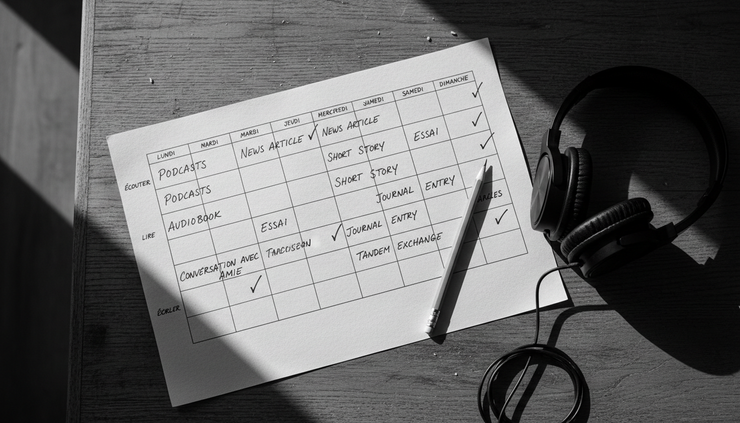
Here is a practical weekly model.
Day | Main task | Output |
Monday | Natural-speed listening | 100-word oral summary |
Tuesday | Grammar for complex sentences | 10 original sentences |
Wednesday | Reading an opinion text | Main idea plus argument map |
Thursday | Timed writing | One structured response |
Friday | Speaking practice | Two recorded answers |
Saturday | Vocabulary by topic | 15 words used in sentences |
Sunday | Review and correction | Error list and improved version |
The most important part is the final column. Passive study does not prove progress. Output does.
Track your errors. If the same mistake appears three times, it becomes a priority for the week.
For example:
If you keep saying `les personnes qui travaille`, review subject-verb agreement.
If every speaking answer begins with `je pense que`, build five alternative openings.
If writing lacks structure, practise only introductions and transitions for a few days.
If listening fails at speed, shadow short clips line by line.
Small corrections repeated daily create the jump.
What success looks like at NCLC 7
NCLC 7 does not feel like native fluency. It feels like control.
You can listen to a news-style audio and identify the main point, speaker attitude, and key details. You can read a formal passage and understand how the argument works. You can write a response with an introduction, reasons, examples, contrast, and a clear ending. You can speak for more than one minute without collapsing into fragments.
Most of all, you can handle unfamiliar topics without panic.
That is the real move from basic to boardroom ready.
To reach this level, stop measuring progress by how many words you “know”. Measure it by what you can do under pressure:
Can you explain a problem clearly?
Can you defend an opinion?
Can you compare two options?
Can you recognise contrast in audio?
Can you write a structured answer in limited time?
Can you correct your most repeated errors?
The plateau breaks when French becomes a tool for reasoning, not only a tool for survival.
If NCLC 5 is the level where you can participate, NCLC 7 is the level where you can contribute with clarity. That is the level official evaluators are looking for, and it is the level serious learners should train for.


Comments